nucleotide
A nucleotide is a molecule made up of a 5-carbon sugar, a phosphate group and a nitrogenous base.
Figure: a nucleotide is one phosphate group and a five carbon sugar, plus a nitrogenous base (Ademine etc).
Nitrogenous bases function as the fundamental units of the genetic code, with the bases A, G, C, and T being found in DNA while A, G, C, and U are found in RNA.
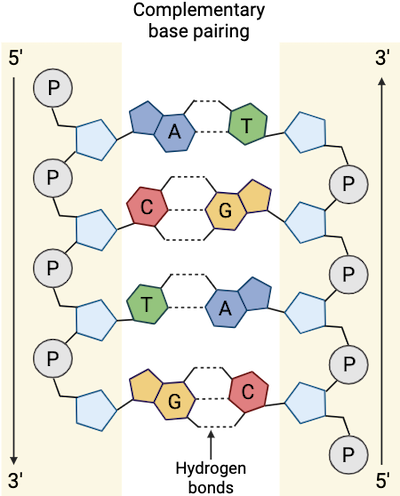
As seen, A and T have 2 hydrogen bonds, called purines. G and C have 3 hydrogen bonds, called pyrimidines.
nucleic acid
A nucleic acid is a polymer of nucleotides. It is acidic and resides in the nucleus of cells, so that’s its name.
Nucleic acids contain the genetic information in all cells.
| DNA | RNA | proteins | carbohydrates | |
|---|---|---|---|---|
| monomers | nucleotides - adenine, guanine, cytosine, thymine | nucleotides - adenine, guanine, cytosine, urasil | amino acids | monosaccharides |
| encodes genetic information | yes | yes | no | no |
| structure | double helix | single helix | ||
| catalyzes biological reactions | no | yes | yes | no |
Nucleotides are the monomers of nucleic acids, and a chain of nucleotides form the backbone of DNA and RNA.
DNA
Deoxyribonucleic acid (DNA) is a polymer of nucleotides.
DNA has high stability compared to RNA due to having thymine instead of uracil.
DNA provides instructions for how and when to make the many proteins needed to build and maintain functioning cells and tissues
In eukaryotic cells, DNA is found in the nucleus of the cell, and the DNA is linear and free floating.
Figure: DNA strands are antiparallel, meaning that one strand goes from the 3’ (three prime) end to 5’ (five prime).
chromosomes
Histone is a type of protein that a DNA strand can wrap around. Histone has a positive charge, while DNA has a negative charge (due to the phosphate groups in its backbone).
A chromatin is a DNA wrapped around histone. DNA is always stored in the nucleus as chromatin because it prevents behaving like a long tangled string.
A chromosome is the most compact form of DNA, because the chromatin is then supercoiled.
RNA
RNA is single stranded and is made of ribonucleotides that are linked by phosphodiester bonds. A ribonucleotide in the RNA chain contains ribose (the pentose sugar), one of the four nitrogenous bases (A, U, G, and C), and a phosphate group.
references
https://www.khanacademy.org/test-prep/mcat/biomolecules/dna/a/dna-structure-and-function