both differential calculus and integral calculus rely on limits.
we have a function
it is discontinuous at , the limit is used to calculate what should be as it gets closer and closer to 1
we can graph this by simplifying
figure: graph of f(x)
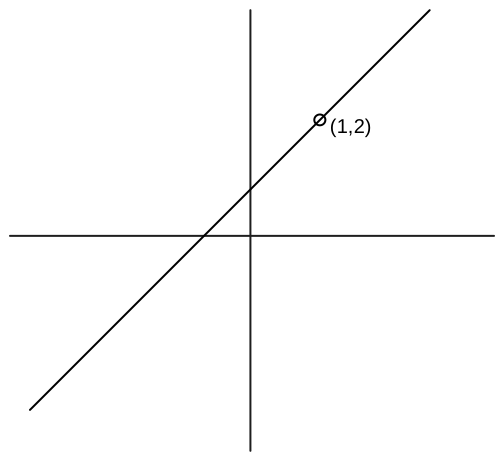
this shows that the limit as x approaches 1 of is 2
worked example: evaluate
direct substitution
worked example: evaluate
direct substitution fail
rearrange
for example, assume
the graph of this function will be the same as , but has a undefined gap at
as we approach from the left hand side, we could get as close to as we want but not reaching it
| x | f(x) |
|---|---|
| 6 | 36 |
| 6.5 | 42.25 |
| 6.9 | 47.61 |
| 6.99 | 48.86 |
we say the limit of as approaches 7 from the left hand side is 49, expressed as
as we approach from the right hand side, we could get as close to as we want but not reaching it
| x | f(x) |
|---|---|
| 8 | 64 |
| 7.5 | 56.25 |
| 7.1 | 50.41 |
| 7.01 | 49.14 |
we say the limit of as approaches 7 from the right hand side is 49, expressed as
because , the limit of as approaches 7 is 49, expressed as
if the values from left hand side and right hand side are not equal, the limit does not exist
if the values from left hand side and right hand side are both infinity or both negative infinity, the limit is unbounded
limit properties
when dealing with limits we have these laws for , , and are constants
if for every in an interval except for when then
if exists and is continuous at then
if the above rule cannot be used you should follow this video
even though the limits do not exist individually they might exist for combinations of functions
for the following rules, if the left hand and right hand combined limits exist then the combined limit exists
limits by substitution
when we know that the function that we have to take the limit of is always continuous, we can find a limit value just by substituting as the limit value
for example, to find we know the function is always continuous, so
see this video
intermediate limits
when calculating limits by substitution and we get
this is intermediate form and you can use methods to calculate the limit
see how to find the limit of an experession
squeeze theorem
let’s say we have three functions, and
if and , we can conclude that
for review, do this exercise
this also means that for a function , the equation of the tangent line at will be equal to
write an equation of the line tangent to the graph of at the point where .
remember: for a function $f$, the equation of the tangent line at $x=c$ will be equal to $y-f(c)=f'(c)(x-c)$

also, $\dfrac{d}{dx}\left[f(x)+g(x)\right] = \dfrac{d}{dx}\left[f(x)\right] +\dfrac{d}{dx}\left[g(x)\right] = f'(x) + g'(x)$

and $f(c)$ is -12

$f'(c)$ is $\dfrac{d}{dx}\left[2x^2\right]+\dfrac{d}{dx}\left[7x\right]$, which is $4x+7$, which is $-5$ when $x=c=-3$

so the answer is $y+12=-5(x+3)$, or $-5x-27$