a exponential function has domain and the range is dependent upon some things
assume we have an exponential function, in the form
one thing about all exponential functions, they all have a horizontal asymptote at the line
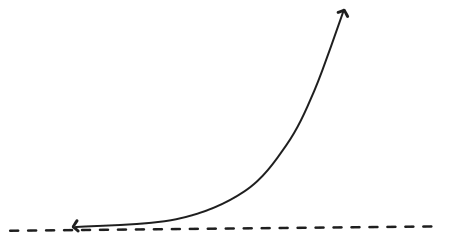
assume that and are positive and , remember how a general exponential function looks like
figure: the general exponential function goes from the left to the upper right
now, we think about other values for , and
if a is negative, there will be a vertical reflection across the asymptote
if is negative, there will be a horizontal reflection
if is in the range , there will be a horizontal reflection
worked example: graph
since the coefficient of is negative, we need to flip horizontally
simplify to the form
since a is negative, there is a vertical reflection across the asymptote
since is positive, there is no horizontal reflection
so our graph is like this

the asymptote is
now find the axial intercepts
x-intercepts
y-intercepts
worked example: graph
simplify to the form
since is positive, there is no vertical reflection across the asymptote
since is negative, there is horizontal reflection
the asymptote is
x-intercepts
y-intercepts
worked example: graph
simplify to the form
asymptote is
since is positive, there is no vertical reflection across the asymptote
since is positive, there is no horizontal reflection
x-intercepts
y-intercepts
worked example: graph
simplify to the form
asymptote is
since is positive, there is no vertical reflection across the asymptote
since is positive, there is no horizontal reflection
siince is in , there is hori
x-intercepts
btw since we know the asymptote is the x axis, we already know there are no x-intercepts
no x-intercepts
y-intercepts