This is a part of guide to graphing functions.
sine, cosine and tangent
we will graph a function in the form ,
and , and
is the amplitude of the graph
is the vertical translation of the graph and the midline is
the period of the graph is for sine and cosine, and is for tangent
the dilation factor from the x-axis is
is the amount of horizontal translation to the right
what do we do?
read your question.
it usually restricts your function domain, for example by defining the function for a domain interval
if there are no restrictions on the domain, just draw everything that should be in the graph and
things we need
- the domain for which we sketch
- midline
- amplitude
- period
- one x-intercept. this can be used to find all x intercepts.
- y-intercept
the period is
to find the coordinates of the y-intercept, set
to find the coordinates of the x-intercepts, if any, set
amplitude is always shown as capital A1
worked example: graph for
amplitude is 2
period is
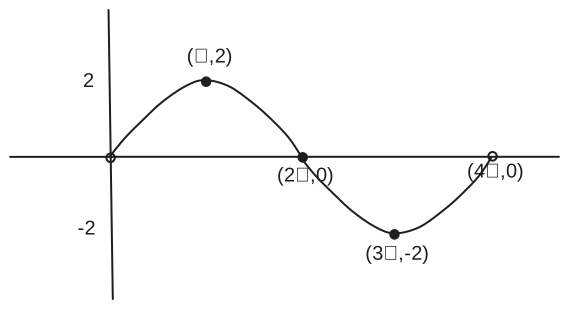
worked example: graph for
amplitude is 3
period is

worked example: graph for
amplitude is is 1, period is , translated to the right

worked example graph
amplitude is 2, period is and translated to the left
calculate y-intercept:
find maximum points
find minimum points
find x-intercepts
worked example: graph
amplitude is 2, period is and translated 1 down
find x-intercepts
worked example: graph
worked example: graph
to graph this we need to put it in the format we recognize by factoring
we need to flip this vertically at the end because negative at the front
amplitude is 2
period is
translation is to the left
midline is
worked example: graph where
period is
find x-intercepts
find asymptotes
worked example: graph where
period is
find x-intercepts
find asymptotes
worked example: graph where
period is
find x-intercepts
find asymptotes
Footnotes
-
: amplitude is often shown as capital A in physics https://en.wikipedia.org/wiki/Amplitude ↩