A trig identity is an equation that involves trig functions.
Remembering trig identities can help you simplify some expressions.
For visualization of these identities, see unit circle. For a better explanation of these identities, see here
And I have a mindmap that is awesome if you can use imagination.
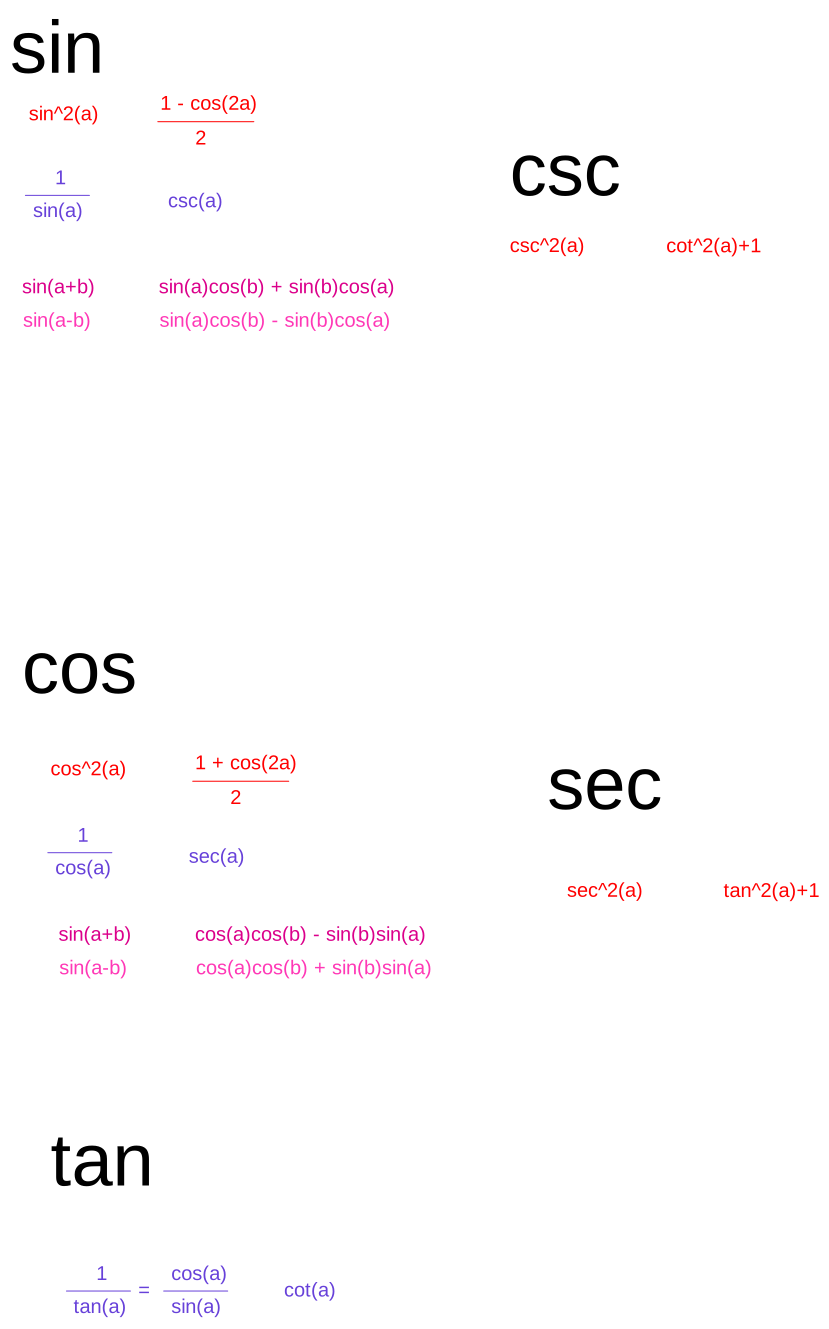
reciprocal and quotient identities
From the definitions of the trig functions, we can express all trig functions with just sine and cosine.
id: 1742684527219
---
==$\tan(a)$== = ==$\dfrac{\sin(a)}{\cos(a)}$==
id: 1742684527319
---
==$\csc(a)$== = ==$\dfrac{1}{\sin(a)}$==
id: 1742684527443
---
==$\sec(a)$== = ==$\dfrac{1}{\cos(a)}$==
id: 1742684527594
---
==$\cot(a)$== = ==$\dfrac{1}{\tan(a)}=\dfrac{\cos(a)}{\sin(a)}$==
Pythagorean identities
Pythagorean identities can be found by applying the Pythagorean theorem to the stuff in the unit circle.
id: 1742684527718
---
==$\sin^2(a)+\cos^2(a)$== = ==$1$==
id: 1744680343868
---
==$\sin^2(a)$== = ==$\dfrac{1-\cos(2a)}{2}$==
id: 1742684528169
---
==$\cos^2(a)$== = ==$\dfrac{1+\cos(2a)}{2}$==
cosecant and secant squared
id: 1742684527943
---
==$\csc^2(a)$== = ==$\cot^2(a)+1$==
id: 1742684527843
---
==$\sec^2(a)$== = ==$\tan^2(a)+1$==
angle sum and difference identities
id: 1742684528819
---
==$\sin(a+b)$== = ==$\sin(a)\cdot\cos(b)+\sin(b)\cdot\cos(a)$==
id: 1742684529219
---
==$\sin(a-b)$== = ==$\sin(a)\cdot\cos(b)-\sin(b)\cdot\cos(a)$==
id: 1742684529594
---
==$\cos(a+b)$== = ==$\cos(a)\cdot\cos(b)-\sin(b)\cdot\sin(a)$==
id: 1742684529918
---
==$\cos(a-b)$== = ==$\cos(a)\cdot\cos(b)+\sin(b)\cdot\sin(a)$==
id: 1742684530168
---
==$\tan(a+b)$== = ==$\dfrac{\tan(a)+\tan(b)}{1-\tan(a)\tan(b)}$==
id: 1742684530418
---
==$\tan(a-b)$== = ==$\dfrac{\tan(a)-\tan(b)}{1+\tan(a)\tan(b)}$==
double angle identities
these are derived from the angle sum identities and Pythagorean identities
id: 1742684530668
---
==$\sin(2a)$== = ==$2\cdot\sin(a)\cdot\cos(a)$==
id: 1742684530944
---
==$\cos(2a)$== = ==$\cos^2(a)-\sin^2(a)$==
id: 1742684531293
---
==$\cos(2a)$== = ==$2\cdot\cos^2(a)-1$==
id: 1742684531568
---
==$\cos(2a)$== = ==$1-2\cdot\sin^2(a)$==
id: 1742684531743
---
==$\tan(2a)$== = ==$\dfrac{2\tan(a)}{1-\tan^2(a)}$==
half angle identities
these are derived from the double angle identities
id: 1742684531868
---
==$\sin(\dfrac{a}{2})$== = ==$\pm\sqrt{\dfrac{1-\cos(a)}{2}}$==
id: 1742684531992
---
==$\cos(\dfrac{a}{2})$== = ==$\pm\sqrt{\dfrac{1+\cos(a)}{2}}$==
id: 1742684532119
---
==$\tan(\dfrac{a}{2})$== = ==$\dfrac{\sin(a)}{1+\cos(a)}$==
symmetry and periodicity identities
id: 1742684532244
---
==$\sin(-a)$== = ==$-\sin(a)$==
id: 1742684532368
---
==$\cos(-a)$== = ==$\cos(a)$==
id: 1742684532493
---
==$\tan(-a)$== = ==$-\tan(a)$==
id: 1742684532594
---
==$\sin(a+2\pi)$== = ==$\sin(a)$==
id: 1742684532693
---
==$\cos(a+2\pi)$== = ==$\cos(a)$==
id: 1742684532794
---
==$\tan(a+\pi)$== = ==$\tan(a)$==
other identities
id: 1742684532893
---
==$\tan(\theta+\dfrac{\pi}{2})$== = ==$\dfrac{1}{\tan(\theta)}$==