intro
A vector is a geometric object with two attributes: a direction and a magnitude.
A vector can be represented as a directed line segment between two points.
For a vector :
- are ways of writing the same vector, choose any lowercase letter.
- is the magnitude of the vector.
- is the unit vector. It is the vector divided by its magnitude. This is a vector of magnitude 1, while having the same direction.
Euclidean vectors can be added and scaled to form a vector space
row and column vectors
matrices with a single row are called row vectors, and those with a single column are called column vectors
for example, the column vector represents a vector where is at and is at . the magnitude of this vector can be calculated using trig:
position vector
A point can be represented relative to an origin point using a position vector, a column vector. If point A is at , the vector from origin to is
addition
Given origin and the coordinates and , we can calculate
dot product
The dot product between two vectors is also known as the scalar product.
The dot product is just a real number such that the sign of the dot product (zero, positive or negative) determines the angle between the vectors (perpendicular, acute, obtuse respectively).
Note that the dot product is commutative since it is related to the angle between two vectors.
For example, for vectors and , the dot product would be
identities
angle calculation
Somehow, we have these to remember.
scalar resolutes
Given two vectors a and b, we can break vector a into two components where one is parallel to b and another is perpendicular to b. The magnitude of the one parallel to b is called the scalar resolute.
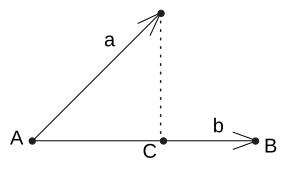
In the diagram above, the scalar resolute is
From Pythagorean theorem we know
Therefore, the part of vector a parallel to b is
Another way to find it involves
We know
To summarize, the scalar resolute of a in direction of b is
vector resolutes
Given two vectors a and b, we can break vector a into two components where one is parallel to b and another is perpendicular to b.
The part of vector a parallel to b is the vector resolute, shown as
We know the scalar resolute,
Therefore to calculate we have
To summarize, the vector resolute of a in the direction of b is
We can find the part of a perpendicular to b with