The cell cycle is events that take place in a cell to divide into two daughter cells.
Cell division is the last phase of the cell cycle, where one cell divides into two.
phases
Figure: A cell spends most of its life in interphase.
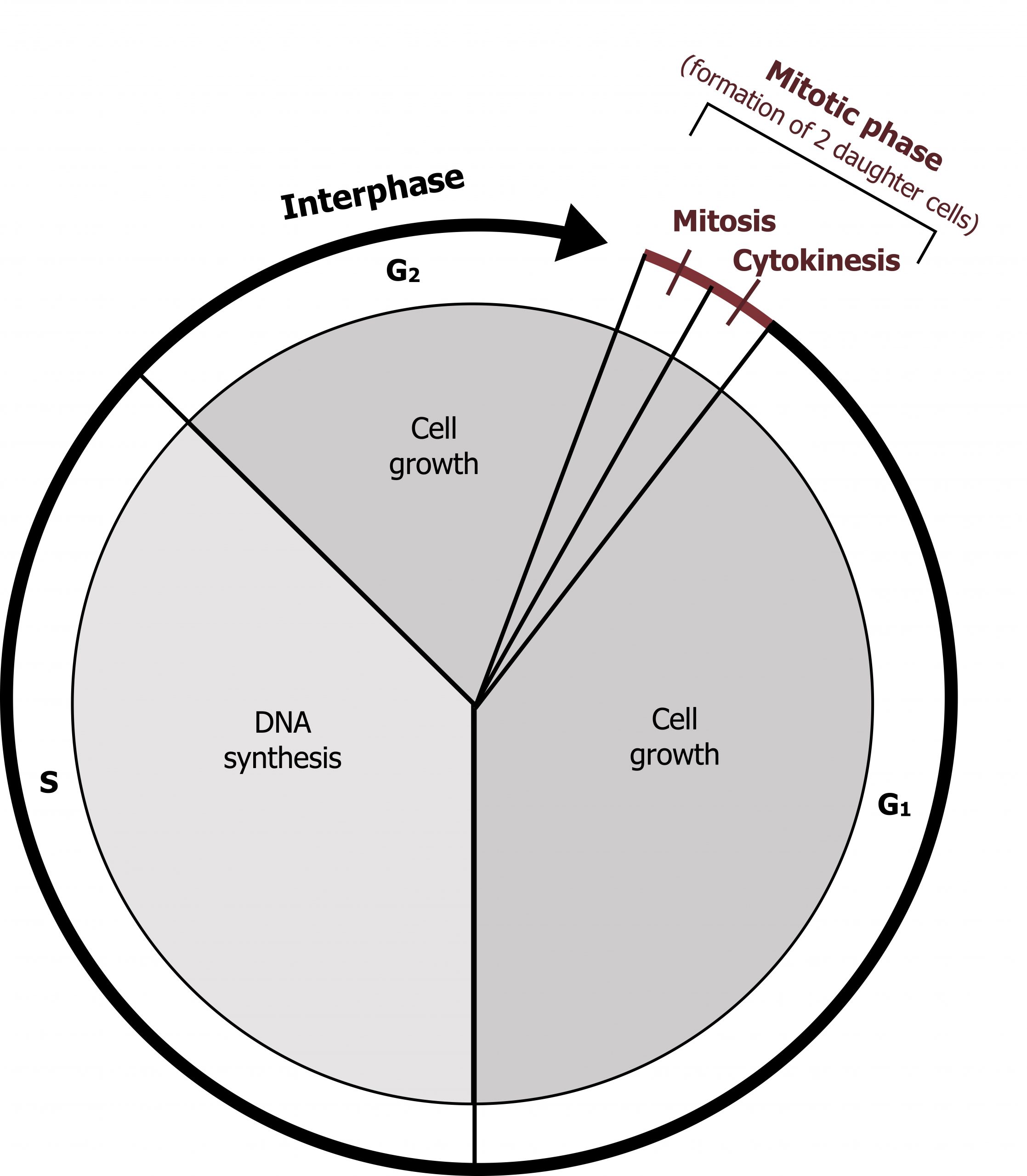
Figure: Summary table.
| abbreviation | phase | description | |
|---|---|---|---|
| gap 0 | resting | The cell is not in the cell cycle and is not dividing. | |
| gap 1 | interphase | Makes sure everything is ready. | |
| synthesis | interphase | DNA replication | |
| gap 2 | interphase | Growth and preparation for mitosis. |
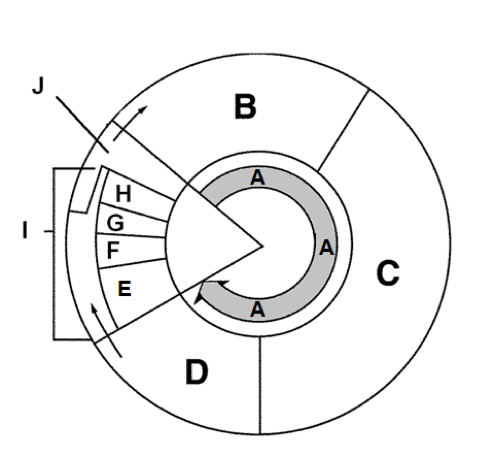
Figure: Label A is interphase, which includes three phases: B is G1 phase, C is S phase, and D is G2 phase. Then it’s mitosis.
checkpoints
Internal checkpoints in the cell cycle makes sure everthing is in order.
If a mutation occurs in the cell cycle, it needs to be repaired.
The cell control system is a group of proteins that regulate the cell cycle. It is active during the 3 checkpoints throughout the cell cycle.
Regulatory proteins are used to control processes within the cell. The cell depends on these regulatory proteins to make decisions and signal for the cell to do things.
A group of molecules called cyclins and CDKs act as gatekeepers for each checkpoint.
The CDK needs to be activated using a cyclin. When those guys are together, the CDK is activated.
- A CDK (cyclin-independent kinase) is an enzyme (a protein kinase) that is responsible for pushing the cell cycle forward. It is activated when it touches a cyclin (a family of proteins).
G0 phase
Only some cells can enter the G0 phase. The cells do not change their structure or size. Hence resting phase.
G1 phase
-
If conditions are not suitable, the cell will go back to G0 phase for resting. Otherwise it will begin G1 phase.
-
The cell is growing fast and making things.
-
Cell differentiation happens.
-
G1 checkpoint. Check DNA damage and repair. Check cell big enough. Check amount of nutrients. Check for external signals causing cell division.
S phase
- DNA replication. Every chromosome is replicated, each producing two sister chromatids.
- The one centriole of the cell replicates.
G2 phase
- Prepare for mitosis.
G2 checkpoint. Check DNA replication. Check DNA damage and repair. Check MPF levels. If everything is good, the CDKs will activate other proteins that break down the nuclear membrane.
mitosis
Mitosis is part of the cell cycle , mitosis , meiosis , cell cycle regulation , apoptosis.
Mitosis is preceded by interphase, during which the cells goes DNA replication
Stages of mitosis: prophase, metaphase, anaphase, telophase, and cytokinesis. You can remember using PMAT.
DNA in mitosis
- A chromatin is a molecule of DNA wrapped around a protein (histone) for compactness. It is the way DNA is stored in the nucleus during interphase (majority of the cell cycle).
- Two homologous chromosomes are called a chromosome pair. The homologous chromosomes were each inherited from one parent. They code for the same genes at the same locations.
- Two sister chromatids are two identical chromosomes, which came from one chromatin undergoing DNA replication. Immediately after replication is done, the sister chromatids must be joined with a centromere that binds them together.
- A chromosomes have telomeres at its ends. They get shorter as the mitosis happens more times.
Figure: Happy.

prophase
- The nuclear membrane dissolves.
- The sister chromatids start to condense, to become more compact. They are more visible.
- The two centrioles move towards opposite ends of the cell.
- Spindle fibers begin to form at centrioles.
- Mitosis checkpoint happens. Check every chromosome is attached to spindle fibers. The spindles must be correctly attached to the kinetochores (proteins on the centromeres). It may send a wait signal until everything is ok.
metaphase
- Sister chromatids line up in middle of the cell.
- Spindle fibers attach to the centromere of mentioned sister chromatids.
anaphase
- Spindle fibers retract and pull the chromatids apart.
telophase
- New nuclear membranes form.
- Chromatids decondense.
- Cleavage furrow starts to form.
cytokinesis
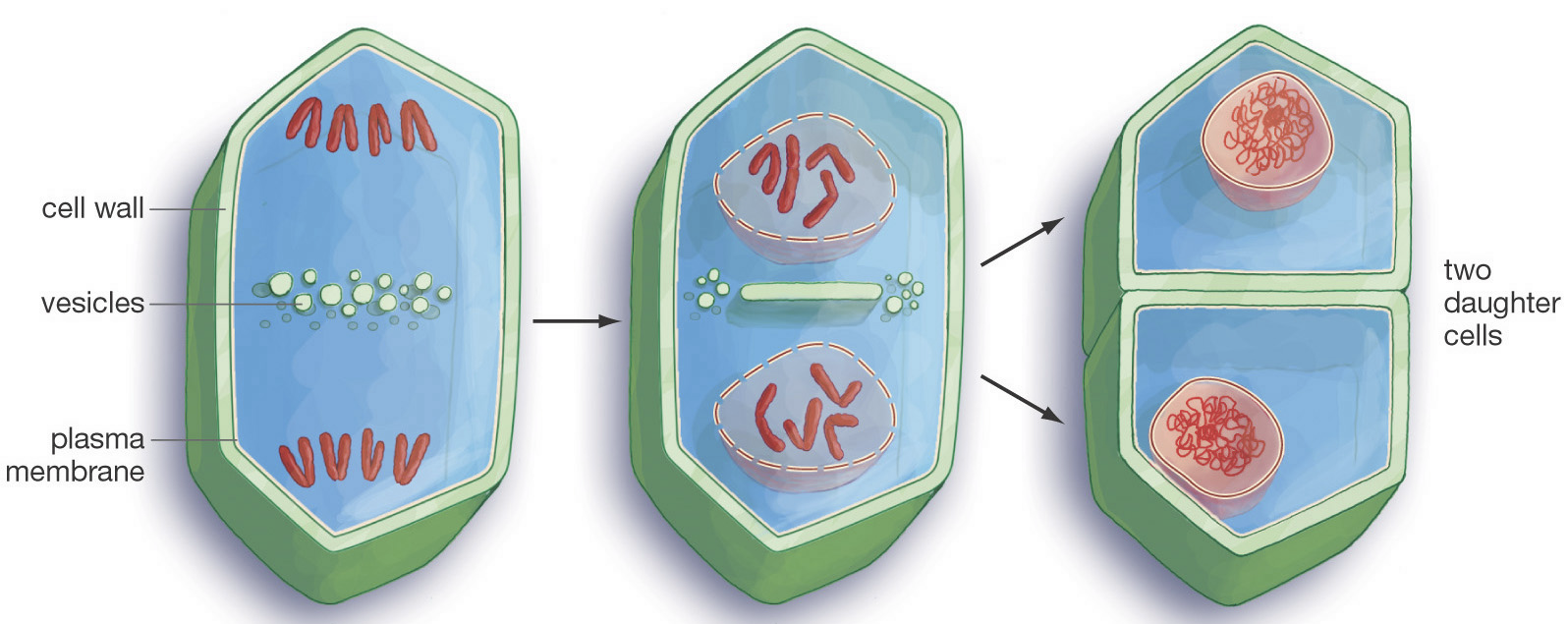
Cytokinesis is the last step in cell division when the cell splits into two.
Figure: In animal cells, the contractile ring keeps deepening the cleavage furrow until division completes.
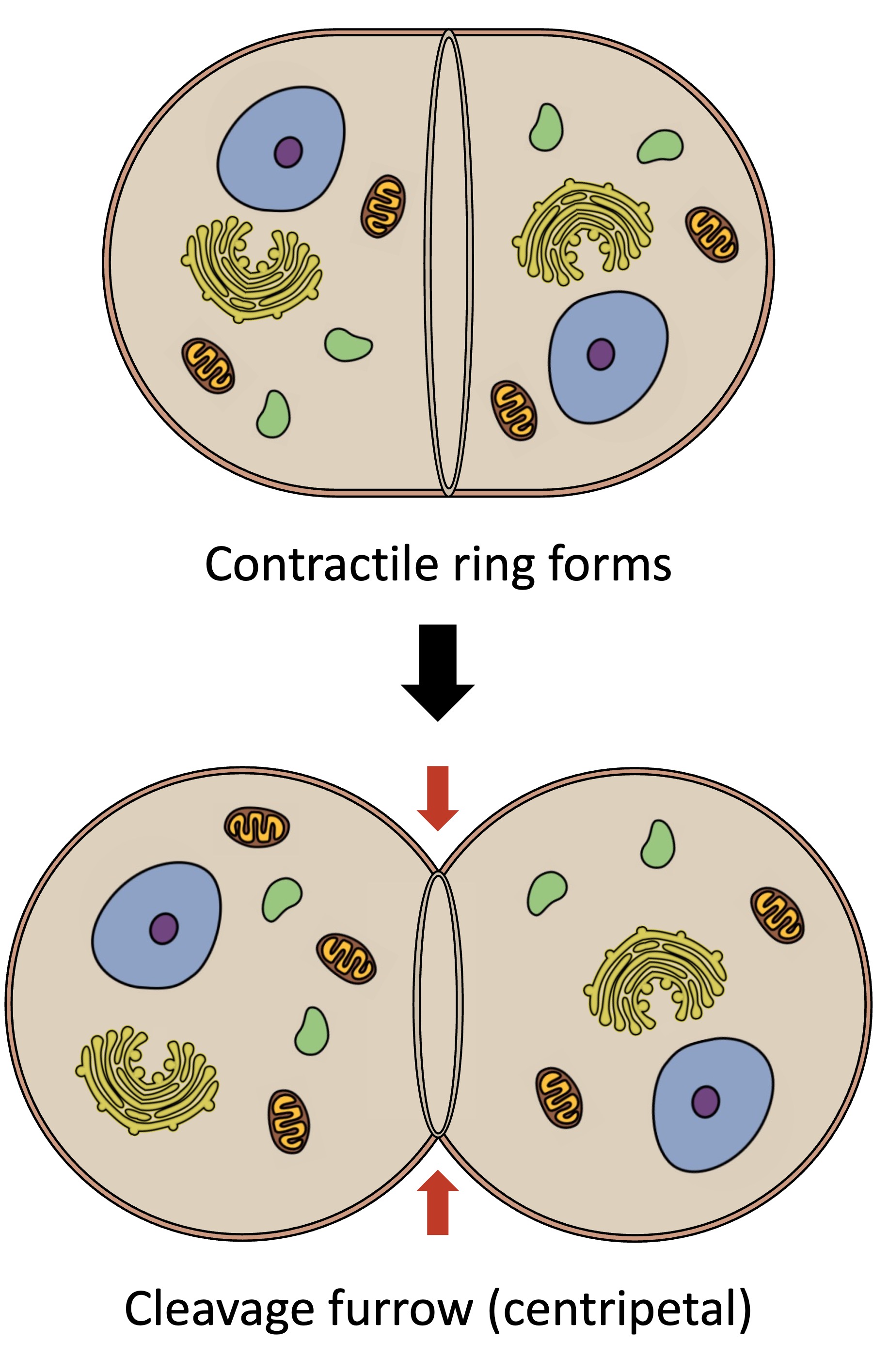
Figure: In plant cells, a cell plate will form, which then becomes part of the cell wall.
meiosis
Meiosis produces two different daughter cells gametes, for sexual reproduction.
Meiosis is a type of cell division that produces gametes in sexually reproducing organisms.
The parent does two rounds of division that ultimately result in 4 haploid cells
Stages of meiosis.
-
prophase I
-
metaphase I
-
anaphase I
-
telophase I
-
prophase II
-
metaphase II
-
anaphase II
-
telophase II
Meiosis I is prophase I through telophase I.
Meiosis II is phases prophase II to telophase II.
Figure 1: Diagram of meiosis.
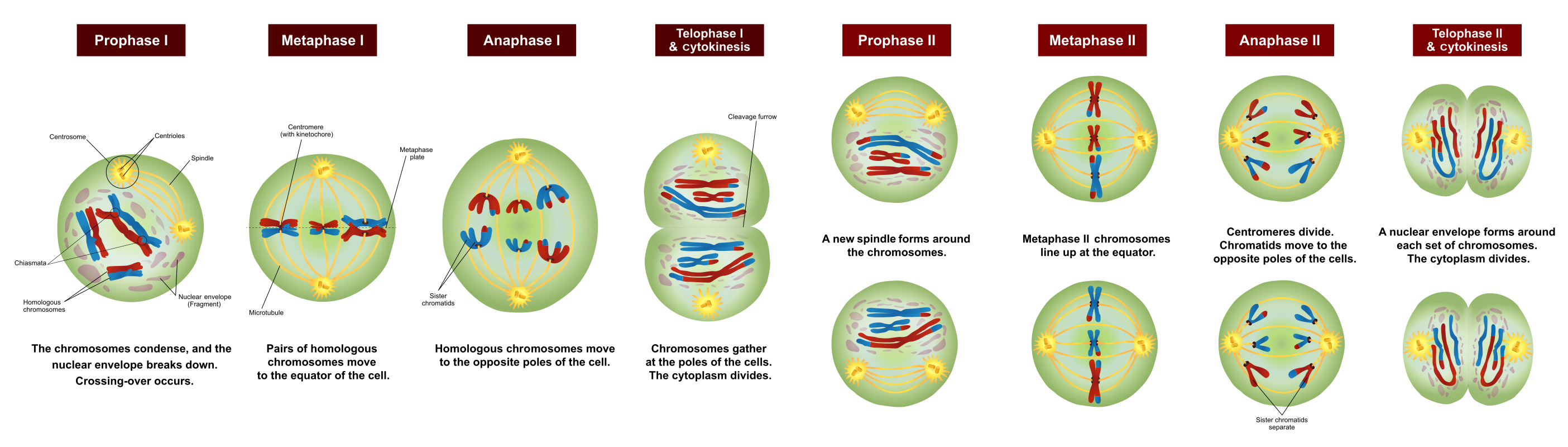
prophase I
Same as prophase, but also add:
- Synapsis occurs between pairs of homologous chromosomes.
- Crossing over and recombination occur between these pairs of synapsed homologous chromosomes.
metaphase I
Same as metaphase, but also add:
- Independent assortment randomly distributes the pairs of synapsed homologous chromosomes.
anaphase I
Same as anaphase.
telophase I
Same as telophase.
prophase II - telophase II
Exactly same as mitosis.
cell cycle regulation
Cells are not supposed to live forever. They need to be replaced as they age.
Sometimes we need to destroy cells that have abnormal growth.
Maybe their DNA is damaged, which would cause disease.
We need cells to die in a programmed manner, called apoptosis.
The cell cycle is regulated by internal and external factors.