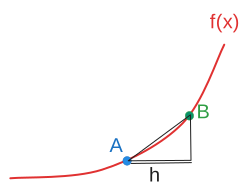
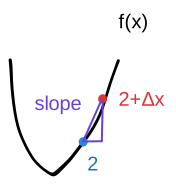
worked example: A secant line intersects the curve y=x2+5x at two points that have x-coordinates 2 and 2+Δx. Express the slope of the secant line in terms of Δx
figure: Clumsy graph here haha
the slope of the secant line here is rise over run, which is Δxf(2+Δx)−f(2) =Δx(2+Δx)2+5(2+Δx)−(22+5(2)) =ΔxΔx2+4Δx+4+10+5Δx−14 =ΔxΔx2+9Δx =Δx+9
worked example: What is the slope of the secant line that intersects the graph of f(x)=0.5−x at x=1 and x=5?
the slope of the secant line is rise over run, which is 5−10.5−5−0.5−1 =432−2 =215
worked example: let A and B be points on the function f(x)=x2+5x+2 at x=8 and x=8+h respectively. find the gradient of line AB in terms of h.
let’s draw something
to find the gradient of line AB, we need hf(8+h)−f(8)
=hh2+16h+64+40+5h+2−(82+40+2) =hh2+21h =h+21
worked example: A secant line intersects the curve y=−2x2−7x at two points where x=−4 and x=t. What is the slope of the secant line in terms of t?
The slope is rise over run, t−(−4)−2t2−7t−(−2(−4)2+28) =t+4−2t2−7t+4 =t+4−2t2−8t+t+4 =t+4−2t(t+4)+1(t+4) =−2t+1
worked example: Differentiate f(x)=2x2−x1 using First Principles