start on calculus
guide to differentiation - a start on calculus
calculus is yours to learn!
exercise - basic differentiation concepts
list of definitions
Now before we start things, I’ve arranged a list of definitions.
Please read.
- The function is the derivative of function .
- “Find the derivative of” is exactly same as “differentiate.”
- The derivative is an operation performed on expressions. The expression has a derivative of . Keep in mind, derivative is an operation on expressions.
- Equations can be made into functions. If you were given , its graph is the same as . Therefore, the derivative of function is just .
- has many different appearances. . We call it a few things, like “f prime of x”, “derivative of f of x”…
derivative rules
What if you knew there was a way that’s easier than using First Principles? It’s derivative rules!
Originally derived from the principles we all know and love, these derivative rules only require you to remember them in exchange for faster differentiating.
constant rule
- Constant rule - derivative of the expression is
variable rule
- Variable rule - derivative of the expression is
power rule
- Power rule - derivative of the expression is
constant multiple rule
- Constant multiple rule - derivative of the expression is
sum rule
- Sum rule - derivative of the expression is
sin(x) and cos(x)
- derivative of is
- derivative of is
things about the number e
- derivative of is
- derivative of is
- derivative of is
- derivative of is
- derivative of is
- derivative of is
guide to differentiation - start application questions
chain rule
- Chain rule - derivative of the expression is
figure: Visual aid here. Hopefully the colors speak louder than words.
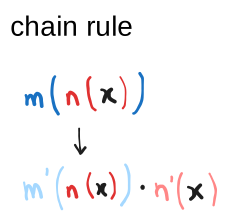
To remember this, we say, outer prime of inner times inner prime.
I made it short for remembering.
The chain rule is used to differentiate many complex expressions.
The chain rule is the beginning of thinking about how many different variables change relative to others.
Let’s use an example to illustrate this.
now, we know that we want the derivative of the equation, which is
So, with this understanding, here’s how to use the chain rule.
You will need to recognize when an expression has nested functions, which you can easily recognize in the form of .
A few examples would be , where you have nested within . Another one is , where you have nested within .
The chain rule states that
Ready? Please check that you understand the chain rule with this.
product rule
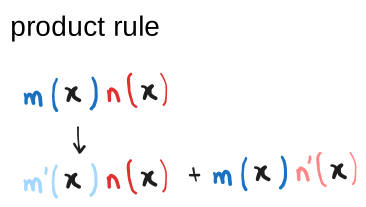
- Product rule - derivative of the expression is
figure: Another visual aid. I love them.
quotient rule
- Quotient rule - derivative of the expression is
Note: You do not need to know the quotient rule, for you can rearrange and use the power, product and chain rules instead. However, the quotient rule is good to know.
figure: Visual aid.
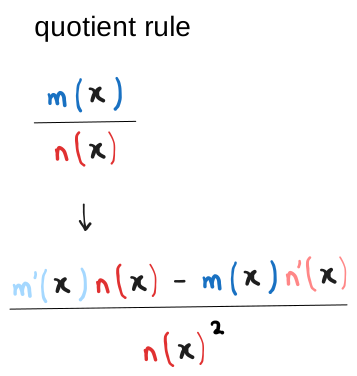
We see that the quotient rule is a bit similar to the product rule.
test your understanding!
exercise - basic derivative rules
exercise - differentiation but a test on your reasoning
exercise - differentiation but messy