differentiation is trying to find the derivative of an expression, equation or function
in differential calculus, the letter when prepended to a variable means “a little bit of” the variable
so just means a infinitely small bit of , in other words an element of or the differential of
the word “integral” simply means “the whole”
if it is the integral from 2 to 3 of , that is all the little bits of in that region together
suppose we have two variables that depend on one another
an alteration in one will cause an alteration in the other
let us call the variables and
suppose we change , to alter it or imagine it to be altered, by adding a bit we call
we are causing to become
because has been altered, will have altered also, and it will have become
and are not variables or constants.
their sole purpose is to act as a placeholder for the concept of change, used to compare to each other
in differential calculus we search for the ratio which is a ratio of how the changes are correlated - this is called differentiating
for no reason, we call the ratio the differential coefficient of with respect to
for example, let and be respectively the base and height of a right angled triangle of which the slope is 30 degrees
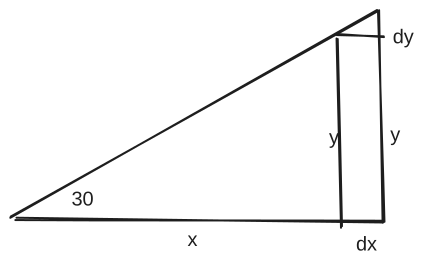
because the angle is 30 degrees,
if we change to become , then would then become
when is 1, must be
expressed as a ratio, is
we just did differentiation! hooray!
a positive can correspond to a negative
for example, suppose we have a ladder against a wall and the angle is unknown
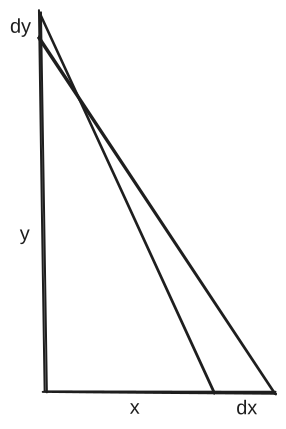
suppose when x is 19 m, y is 180 m
when is 1, what will be?
we know that the length of the ladder is constant, m
because , we know that
we know that a length has to be positive
we know that y is 180
what is meaning of implicit function and explicit function?
explicit functions express in terms of or express in terms of
for example, is implicit whereas is explicit
whenever we use differentials , , etc, the existence of a correlation between the variables is shown, expressed with functions
when the exact function between several quantities x, y, z is unknown or is not convenient to state it, it is assumed that there is some sort of function between these variables and one cannot alter any of them without affecting the other ones
this function is expressed implicitly with or explicitly with
suppose we have the equation
let us change x so that it becomes
this causes a change in y so now y becomes
now begins the differentiation, aka finding
so what does mean? it is a infinitely tiny amount squared which places it in the second order of smallness, nonexistent compared to the other terms
substitute
suppose we have the equation
we let become and will become
remove the too small things
substitute
have a look at representing functions
keep in mind that when we differentiate a function such as , we are saying that and the can be simply represented as and where
in other words, the following statements represent the exact same thing
- for
- for
now you are ready to learn the power rule
if and is a positive integer, then
for example, if ,
worked example:
if then
see derivatives page and you can see the differential rules
we can practice the power rule by solving these
note: questions that require you to find the derivative of an expression uses one of these formats. just wanted to say that these are different ways to say the same thing
- find the derivative with respect to x () of this expression
- for , find
- differentiate the equation
- for , find
- find the equation of the tangent line to the graph of
worked example: find derivative of each of these expressions