when we flip an angle over the line , we have equations called complementary relationships
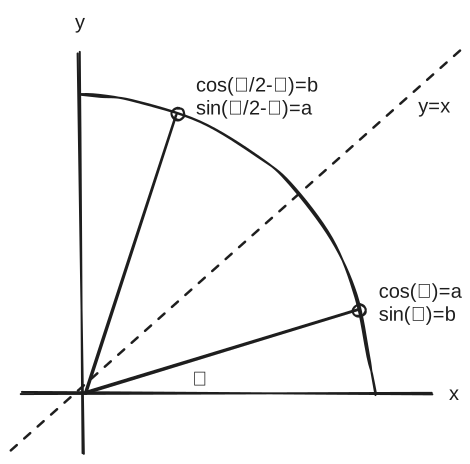
from the figure above, we can see that
apply this for a general rule, we see that for angle , and is an odd integer:
practice complementary relationships
worked example: if and and they are both in the first quadrant, evaluate
applying signs
since angle is in the first quadrant, is also in the first quadrant, where sine and cosine are both positive
worked example: if and and they are both in the second quadrant, evaluate
applying signs
since angle is in the second quadrant, is in the third quadrant, where sine and cosine are both negative
\worked example: if and and they are both in the third quadrant, evaluate
applying signs
since angle is in the third quadrant, is in the second quadrant, where sine is positive and cosine is negative
worked example: if and and angle is in the first quadrant, evaluate
applying signs
since angle is in the first quadrant, is in the third quadrant, where sine and cosine are both negative, and tangent is positive