intro
The normal distribution is a function defined as , where mu and sigma are constants, the mean and the standard deviation respectively.
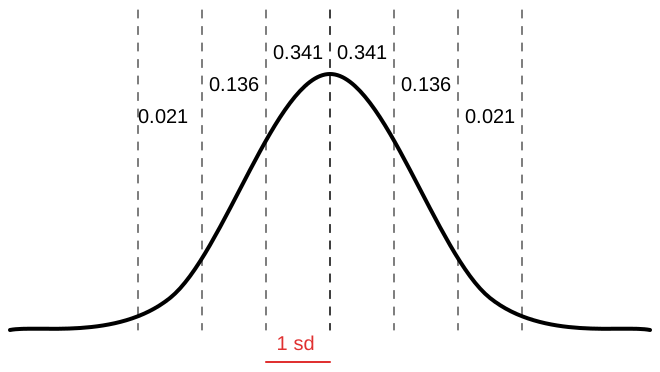
Figure 1: Some numbers you can memorize, the probability of being in some areas of the graph. Most of the probability is covered within these 6 standard deviations.
Assume a random variable X that is normally distributed with a mean of 12 and a standard deviation of 3.
The variance is defined as the standard deviation squared, that is, .
PDF and CDF
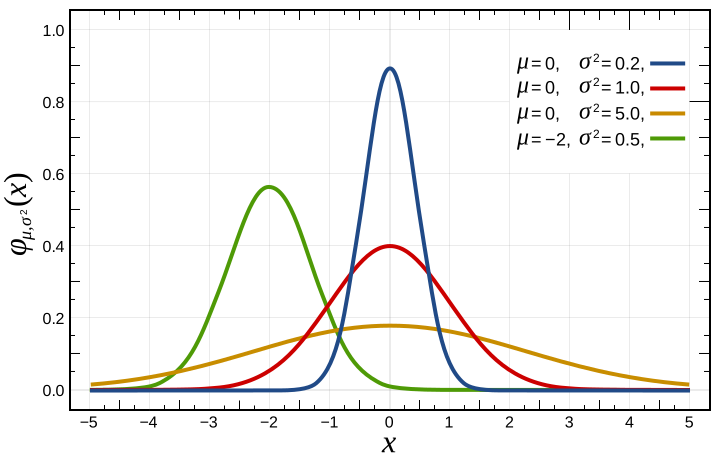
The graph of a normal distribution is a probability density function, that is, it shows which numbers of the x axis is more probable.
When trying to get the coordinates of a single point, some calculators require 3 inputs: normPdf(x,mean,stddev), which outputs the corresponding y value.
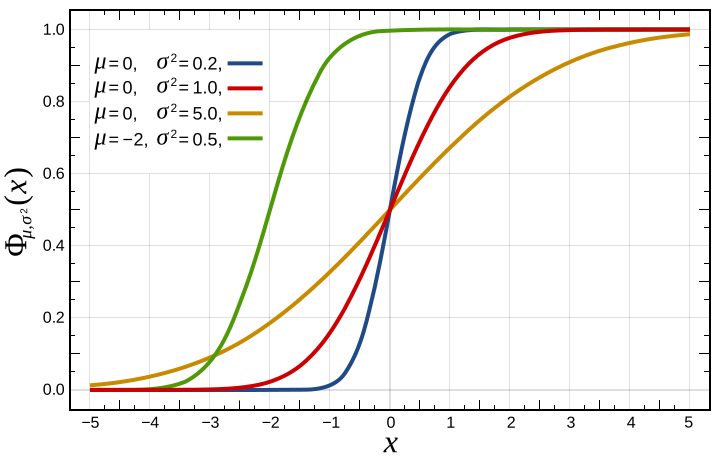
The cumulative distribution function is another function that returns the area cumulated.
In other words, it is the antiderivative of the normal distribution
When trying to get the probability of the variable being between constants a and b, some calculators require 4 inputs: normCdf(a,b,mean,stddev), which outputs the total area sum within the set range.
linear transformations
When a normal distribution undergoes a linear transformation in the form , the original becomes and original variance becomes . Therefore, the original standard deviation becomes .
samples
The normal distribution describes the probability density for a single sample.
A sample of 1 from the normal distribution is shown as .
A sample of 5 from the normal distribution is shown as .
transformations
linear sum for different random variables and etc…
sum of identically distributed but independent variables and etc…
So and have the same distribution but are independent from each other, such as choosing apple one and apple two from somewhere. Note this is different from choosing one apple and cloning it to get two apples.