A probability is a numerical measure of the chance of a particular event occurring.
It can be determined experimentally or by using logic.
overview
Probability contains:
- Discrete probability includes only a limited amount of outcomes, including the binomial distribution.
- Continuous probability includes a continuous range of outcomes, including the normal distribution.
- Sampling questions can include elements of both discrete and continuous probability methods, you need to distinguish what tools to use.
A trial can be repeated under the same conditions. A trial must result in one of the possible outcomes. All possible outcomes must be known before the trial begins.
An event is depicted with a capital letter. \for an event , the probability of is shown as and .
The union of events and is shown as and means the situation where either event happens or both events happen. This is read as A or B.
The intersection of events and is shown as and means the situation where both events happen. this is read as A and B.
addition and multiplication rules of probability
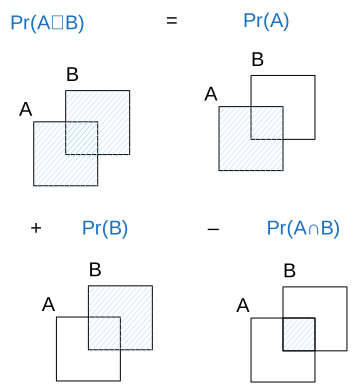
The addition rule says . This comes from adding both probabilities, and subtracting the overlap between them.
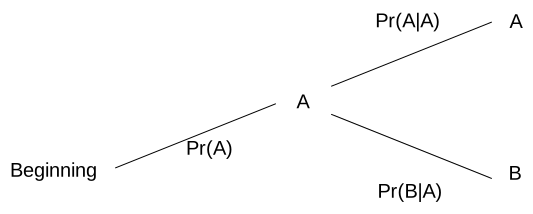
The multiplication rule says . This is derived from a tree diagram. As you can see, the probability of both is equal to and multiplied together, where the second one is “probability of B given A”.
Two events and are mutually exclusive if . There is no possible overlap between the events.
Saying two events and are independent is equivalent to saying and and . This means that the events are not related to each other.
A two-way table, aka Karnaugh map, is very useful to visualize the relationships between two events.
| A | A’ | ||
|---|---|---|---|
| B | |||
| B’ | |||
| 1 |
Note that .
conditional probability
the probability of an event occurring given that another event has already occurred is called conditional probability.
the probability of given that happened is depicted as , the probability of given
to calculate conditional probability we use an equation derived from the multiplication rule of probability,